Lucy Fitzgerald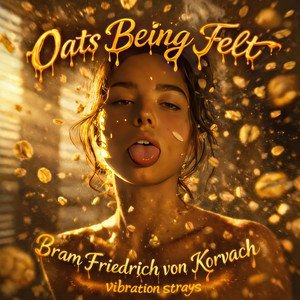
Q: Hi! So first off, “Oats Being Felt” is such a unique title – where did that phrase even come from?
A: It came from the phrase “feeling your oats,” which means feeling great, maybe frisky and playful, and just enjoying life. The song itself is about a person waking up, feeling good, deciding to make oatmeal for breakfast, and having that tactile experience of pushing their fingers through a bowl of dry oats while the kettle heats up. Literally: feeling your oats. Or we’ll go with “oats being felt,” because the track might lead you to believe the oats have opinions about this too.
Q: When you were making this track, what kind of headspace were you in day-to-day?
A: I was trying to make something that would add a bit of enjoyment to someone’s day. Many people wake up and struggle to have something basic to eat; even oats would be a blessing. Many more do not wake up and “feel their oats” because of work stress, economic stress, family stress, and the ordinary problems of daily life. So I wanted a song that quietly asks: “What would life be like if things could show up a little differently for me today?” It offers a small vision of setting your cares aside for a few minutes each morning. You can have all of your cares when you are done. The sentient oats community hasn’t yet gotten back to me on that proposal – I suspect it is mostly because they keep getting eaten – but maybe the song will at least help us mere humans be a tiny bit happier.
Q: I get the sense there’s a bit of routine or early-morning energy tied into this song – are you someone who actually enjoys those quiet early hours?
A: Late nights and very early mornings are when I get my best work done, music or otherwise. But sometimes inspiration hits at a strange hour, and I have to drop everything to capture it. When I have a vivid dream, I will immediately leap up and record it. Some of the best ideas come during those moments.
Q: How do you usually know when a track is “done,” especially one that feels a bit abstract like this?
A: Engineering has been my life’s work, and I make no secret of using AI-assisted and other technical tools to produce music. Everyone is worried about AI-assisted music, but I hope my work shows that AI is just a tool, and that the output from modern tools can and should be exceptionally high quality. By the time a song is published, I will have personally listened to it, tinkered with it, and modified it perhaps 50 times or even up to 300 times in cases where I still could not leave it alone. That does two things: it ensures that the piece meets my best available technical and creative standards, and it ensures that the song doesn’t go stale with repeated listens. Each piece is a labor of love, and each one should stand on its own as a beautiful work of artistry.
Q: You’ve been dropping quite a bit of music lately – do you feel like you’re in a particularly creative streak right now?
A: People in my inner circle tend to know me as extremely creative and productive. Only recently have I turned attention to musical pursuits, so you are going to see a lot of output. There is easily a backlog of thousands of song ideas and partial lyrics piled up in my notes. When an idea comes automatically, I note it down. Some of the really crazy upside-down ideas are the best ones. I am after lyrics and music that haven’t been done before and that genuinely push the industry forward. People might call it experimental because they do not yet know what to make of me or the music, but that is exactly what keeps music fresh and interesting. If every song makes someone say, “Wow, that was awesome,” I would consider it a success.
Q: What’s one small detail in this song that most listeners might miss, but you’re really proud of?
A: The song was an effort to work an electric harp into a gnarly rock/country beat. Some folks mistake it for a mellow guitar, but the harp drops in there with the heavier guitars and drums, especially at the opening and the ending. The rest of the song stands on its own, but I think the harp sharpens it and gives it charm. Let’s just say this is not a harp being played at a wedding. If you want a wedding harp, try “Heart Strings” from my Love and Devotion album.
Q: Do you approach songwriting more from a feeling first, or do ideas and concepts come before the sound?
A: It happens in two ways, depending on the song. Sometimes I get a sound motif in my head and make an instrumental piece out of it. You will hear quite a few instrumentals in the Hard Blows and Hard Harping series of albums. The single “New Ice Cream Flavor” is another example; it just captures the feeling of trying a new ice cream. In those cases, you get the full meaning from the music itself.
Other times, I will take an interesting instrumental composition and layer in clever lyrics. Sometimes a piece simply demands words. An example is “Sedated Dematting,” where the piece consists of gorgeous concert harp work, including the percussion, plus a vocal track that goes after a real issue.
Lately I have been working with flute, harp, and saxophone. I am taking apart one of my violins to try to improve it. One new track I am developing uses glockenspiel. If the output shows how these instruments can show up and add real musical meaning alongside AI-assisted tools, then I will have achieved my goal.
Q: There’s something kind of introspective about your releases – do you see your music as personal expression, storytelling, or something else entirely?
A: (thinking) Probably a personal healing journey would be the short answer. The three Reverse Werewolf albums are storytelling records because they lyrically tell the story from my book, The Reverse Werewolf. That project came out of my long-term insomnia; after a while I noticed it tended to flare around the full moon, with a lesser effect on the new moon. I don’t grow hair and prowl about on full moons – my neighbors are very happy about that – but it did get me thinking about werewolf lore. From that came the book and the three albums. It was intense: roughly 1,750 songs surfaced during those insomnia episodes, and only around 45 made it into the published body of work. My next two books, Sofa Sitting and one about Harald Bluetooth, will also have accompanying albums. Every piece of fiction I write will have a music component. That said, I also enjoy making simpler music that is not trying to tell a story at all. Sometimes all it needs to be is a nugget of honest meaning.
Q: How important is experimentation for you at this stage – are you actively trying new things with every release?
A: Experimentation is the game here. Exploration too. The lyrical concepts are diverse, and there is not always a clean way to park a song in a genre. That is intentional, even if it probably hurts my marketing, because you cannot just put everything in a nice box and label it. To make matters worse, I also write in Spanish, Hebrew, Ukrainian, and German. I am pushing myself to make those songs real, legit, high-quality, listenable pieces. They may not be perfect, but I keep working on the pronunciation with native speakers.
A specific example: I have English songs titled “Gazing in Gstaad” and “Gestalting in Gstaad.” Gstaad is a word just as marvelous as the resort town in Switzerland because many people cannot say it correctly unless they speak German. I wanted to see whether an AI voice could say it – let alone sing it – and that opened up a larger set of questions about voice, tone, and accent.
So yes, expect more experimentation, more Gstaad songs, more English and non-English songs, and other things not yet invented. There is a piece sung in Yoruba in progress. If it’s any good, you might hear it on your streaming playlists or on the radio.
Q: If someone’s hearing your music for the first time through this track, what do you hope they take away from it?
A: The song is just about having breakfast. Just wake up and enjoy it.
Q: Looking at your recent run of singles, do you see them as separate moments, or are they all part of a bigger picture you’re building?
A: Singles are separate moments. If I think something is worthy of someone’s time, it gets released. The editorial outlets won’t like that because I tend to just push out what worked. Look for many more full albums.
If there is a bigger picture here, it is that AI tools are here to stay, so lets make the most and the best of them. My music stands as a monument to that bigger picture.
Q: And zooming out a bit – what’s next for you for the rest of this year? Are we getting more singles, a project, or something totally unexpected?
A: 2026 will be full of exceptional music, both albums and singles. Two more books as well. I know everyone will have their own opinions, and that is fair and reasonable. Actually, I invite the input, good or bad or ugly, because that is how I stay humbled and learn how to become better at what I do. If I’m doing it right, I hope to keep learning, keep surprising you and never disappoint. We are just getting started.

Listening to songs so you don’t have to! Just kidding :D, you totally should. Music blogger by day, nurse by night